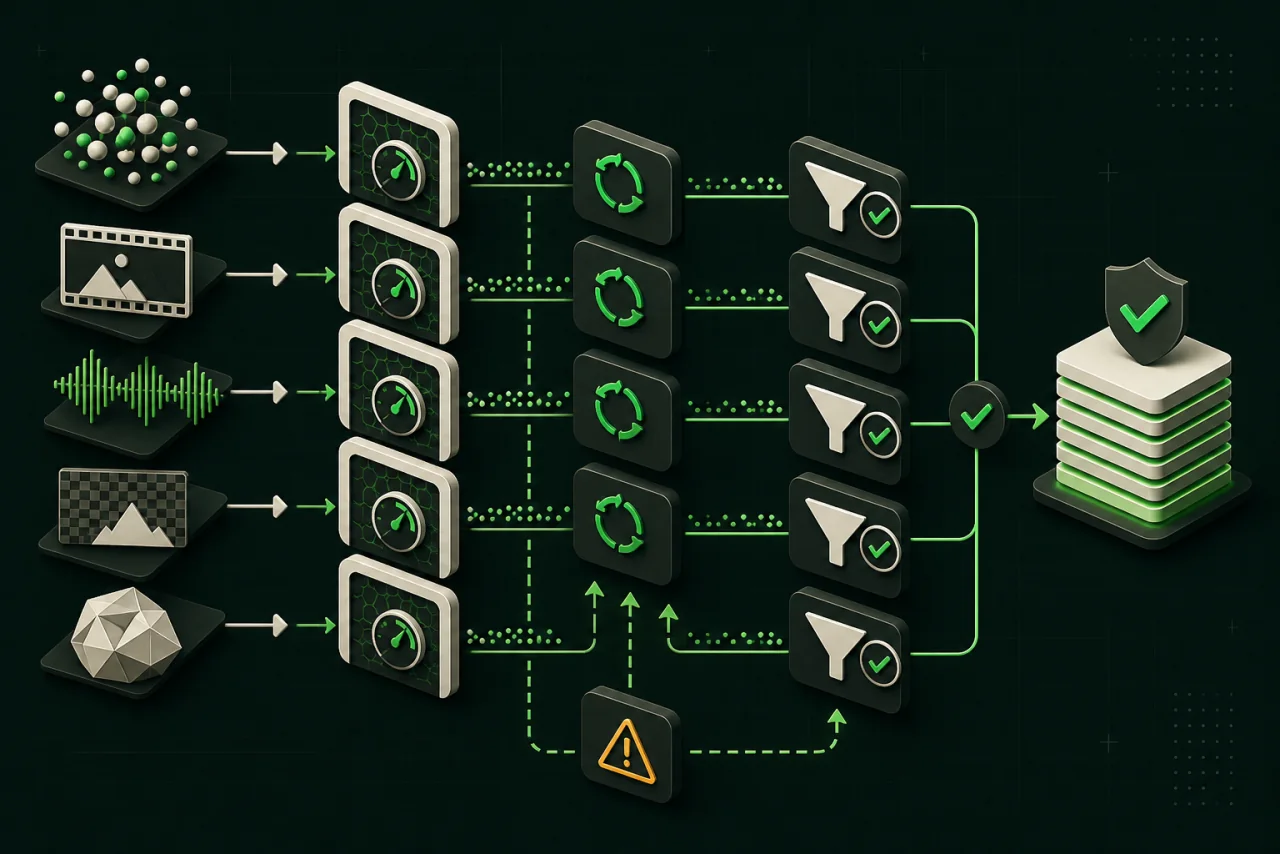
3D pricing follows a pipeline
A 3D API may charge credits for a preview mesh, a refined texture, image-to-3D, remeshing, conversion, resizing, rigging, or animation. The cheapest generation call is not the cheapest usable asset if the result still needs topology repair, UV work, texture regeneration, format conversion, or an artist. Write down the exact operations that every accepted asset passes through.
Use the calculator with the credit requirement of each selected operation and the effective price paid for one usable credit. A subscription allowance and a top-up can imply different effective credit rates; do not assume a nominal credit has one universal cash value. Keep the official credit table and purchase terms with the benchmark date.
Benchmark production constraints, not a spinning preview
Create test sets for characters, products, hard-surface objects, organic shapes, thin parts, symmetry, transparent materials, and multi-view references. Inspect geometry rather than only rendered screenshots. Score silhouette, topology, holes, self-intersections, UV layout, texture seams, material correctness, scale, orientation, polycount, and compatibility with the target engine or DCC tool.
Record generation mode, model version, seed, input images, target polycount, texture resolution, output format, rigging option, and every post-process. Measure total time and artist minutes to an accepted asset. An API that produces attractive previews but fails the downstream import or animation gate does not pass.
- Separate preview and refine operations when the provider exposes both.
- Test the actual GLB, FBX, OBJ, USDZ, or STL path your product ships.
- Confirm whether texture, remesh, rigging, and animation are separate credit events.
- Review commercial use, training-data, likeness, and generated-asset terms.
Use the official Space for capability discovery only
The embedded Tencent Hunyuan3D Space below is an official public demonstration and is loaded only after you click. It is useful for understanding inputs and visible outputs, but it is not an APIDir benchmark, uptime promise, production API, or price source. Space availability and compute queues can change independently of a commercial endpoint.
For purchasing, call the documented API or provider route with a bounded benchmark, retain raw assets, and inspect them in the production toolchain. Keep the Space behind an isolated optional component so a third-party outage leaves the article and calculator usable.
Common comparison mistakes
- Comparing generation credits while omitting texture, remesh, rigging, or conversion.
- Approving a rendered preview without inspecting the exported geometry.
- Using one effective credit price across plans, top-ups, or enterprise terms.
- Treating a public demo Space as a production API or uptime commitment.
- Ignoring artist cleanup and engine-import failure in accepted-asset cost.
Questions developers ask
How should I compare 3D model API pricing?
List every required pipeline operation, normalize credits to cash, measure accepted assets after geometry and texture review, and compare total cost per pipeline-complete asset.
Is the Hunyuan3D Space a commercial API?
No. It is an official public demonstration for capability discovery. Use documented API or provider terms for production, pricing, limits, and support.
What should a 3D acceptance test include?
Inspect silhouette, topology, intersections, UVs, textures, scale, polycount, format import, and any rig or animation requirement in the actual downstream toolchain.