Cost decision center

AI API pricing comparison by real workload

Normalize the meter, model configuration, retries, and accepted output before deciding which AI API is actually cheaper for your product.

One page · one buyer job

AI API pricing comparison

Checked Aug 22, 2026

Turn unlike provider meters into one cost per accepted product output without inventing a universal cheapest-provider claim.

First decision
Fix the model and output configuration
Comparable meter
Cost per accepted output
Never collapse
Tokens, seconds, images, credits, and GPU time
Recheck
Official rate and account terms before purchase

Normalize one provider quote

Enter a current first-party unit rate and your own acceptance rate. Example inputs are illustrative and are never provider quotes.

The usable outputs your product must deliver, after review.
Copy the exact current rate for the fixed model, route, mode, and output configuration.
Usable outputs divided by all billable attempts in your own benchmark.
Plan minimums, support, storage, monitoring, or another known fixed amount.
Reset example

Planning result

Review the example inputs, replace the rate with the exact current provider rate, and calculate a workload. APIDir does not send these values to a provider.

Pick the correct denominator

Cost calculators by API workload

Each URL owns one buying intent and one billing logic. Video keeps its existing source-linked calculator.

Video calculator →
cheapest LLM API

Find the cheapest LLM API for your workload

Estimate the blended token bill for one production workload and identify which route is economically viable after non-price requirements.

Open calculator →
cheapest image generation API

Compare the cheapest image generation API by accepted asset

Compare image APIs at one fixed output specification and budget the attempts required to deliver approved assets.

Open calculator →
background remover API

Compare a background remover API by accepted image

Choose a background removal API that meets edge-quality and throughput requirements at the lowest cost per approved product image.

Open calculator →
cheapest TTS API

Find the cheapest TTS API for delivered speech

Estimate the cost of approved synthesized speech and shortlist a TTS route that meets voice, language, latency, and policy requirements.

Open calculator →
dubbing API

Calculate dubbing API cost per delivered language minute

Estimate automated dubbing plus review cost for a multilingual release and choose a workflow that meets language, speaker, timing, and rights requirements.

Open calculator →
3D model API

Compare a 3D model API by production-ready asset

Estimate the complete cost of accepted 3D assets and shortlist an API whose geometry, texture, format, latency, and rights fit the product.

Open calculator →
LLM GPU cost calculator

LLM GPU cost calculator for API versus self-hosting

Determine whether self-hosted inference deserves a technical benchmark based on monthly API spend, GPU rental, operations, and break-even volume.

Open calculator →

The cheapest headline is often the wrong denominator

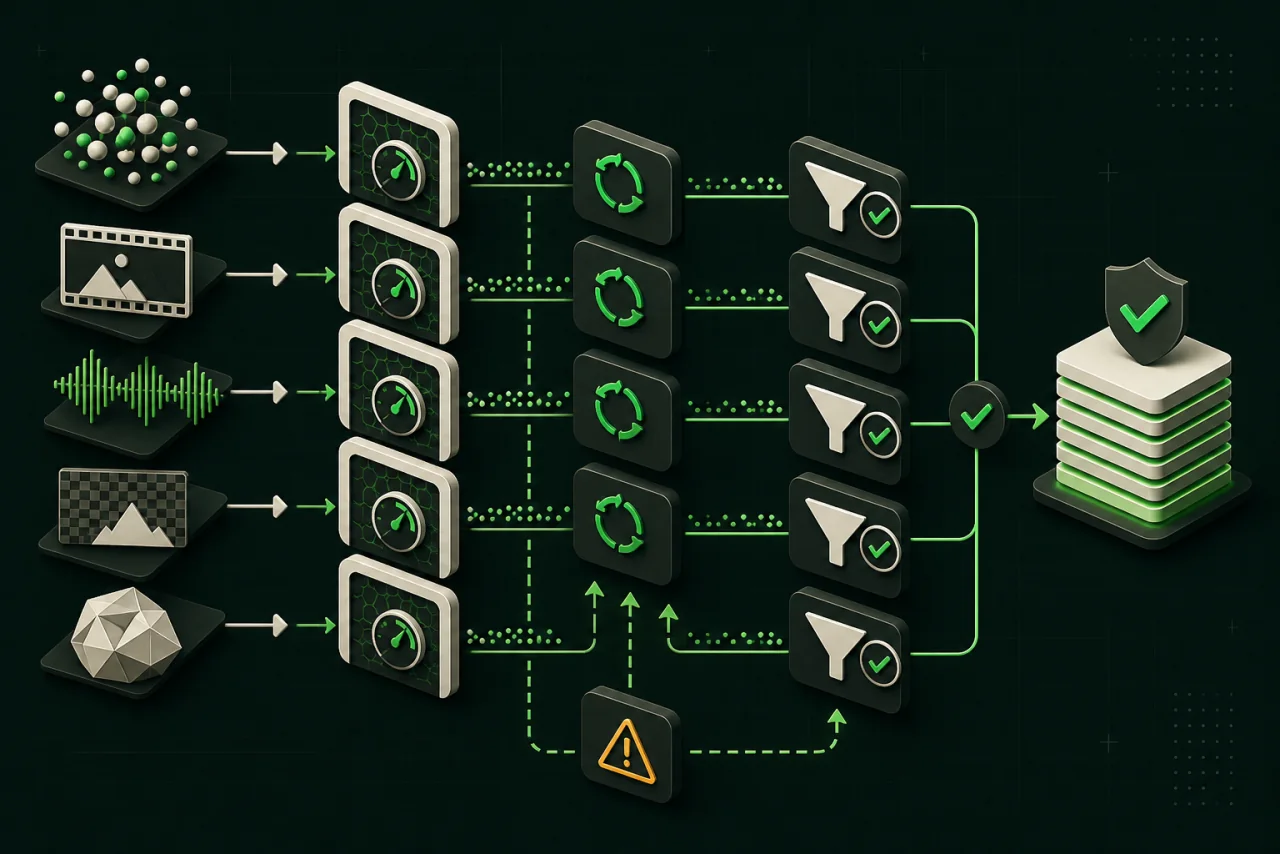
An AI model pricing comparison can look precise while mixing different denominators: input tokens, output tokens, cached tokens, requests, generated images, megapixels, video seconds, characters, source minutes, credits, or GPU time. A lower-looking number is meaningless until both offers describe the same model, route, quality setting, output size, duration, audio mode, region, and processing tier.

APIDir starts from the product output you need. If the product needs 10,000 approved images, compare the full cost of producing those approved images—not 10,000 raw generations. If a workflow needs one localized minute in five languages, compare five delivered target minutes plus rerenders and review. This denominator makes a pricing page useful to a buyer instead of merely sortable.

  • Copy the billing unit and price from the exact official model or endpoint page.
  • Freeze every material configuration field before comparing providers.
  • Measure acceptance, retry, and failure behavior with the same test set.
  • Add fixed plan, storage, moderation, network, and support costs separately.

Use the calculator family as a funnel, not a fake leaderboard

Each calculator below serves one buying job. The LLM page converts token and cache assumptions into monthly spend. Image and background-removal pages measure accepted assets. TTS keeps provider-native characters or UTF-8 bytes explicit, dubbing counts target-language minutes, 3D follows the asset pipeline, and the GPU calculator screens API versus self-hosted economics. The existing video calculator stays focused on source-linked video offers.

A result is intentionally shareable through its query string but marked noindex, so search engines index one clean canonical page rather than thousands of input combinations. Calculations run on the server with bounded numeric inputs and no provider credential. If a provider page is unavailable, the calculator still works because the user supplies the current rate.

A procurement shortlist needs more than price

After two offers reach the same effective unit, compare rate limits, cold starts, latency distribution, regional availability, data retention, model version pinning, safety behavior, output rights, support, observability, and exit cost. A router can reduce integration work and add fallback choices, while a direct provider may expose a different contract or control surface. Those are architecture decisions, not fields to hide inside a single dollar number.

Run a small paid benchmark before committing volume. Keep raw requests, provider request IDs, usage fields, failures, accepted outputs, and invoices. Reconcile the estimate to the first real bill, then replace every assumption with observed values. The result becomes a durable unit-economics model instead of a one-time pricing screenshot.

Common comparison mistakes

  • Sorting price strings without converting their billing units.
  • Comparing a direct API with an aggregator while ignoring routing, fees, and fallback behavior.
  • Treating free credits or a temporary promotion as the long-run marginal rate.
  • Ignoring rejected outputs, client errors, minimum charges, and plan commitments.
  • Publishing a cheapest claim when fewer than comparable fresh offers pass the evidence gate.

Questions developers ask

What is the cheapest AI API?

There is no universal cheapest API. Fix the model, route, quality, meter, workload, and acceptance rule, then compare cost per accepted output using current first-party rates.

Does APIDir copy live provider prices into this calculator?

No. You enter the current rate from the linked official source, which prevents an old hardcoded price from silently becoming a purchasing recommendation.

Why are calculated query URLs noindex?

The inputs are useful for sharing but do not create a new editorial page. One canonical clean URL prevents duplicate and near-empty search pages.

First-party boundaries

Official sources to recheck

These links define meters and product boundaries. APIDir does not freeze their current rates inside the planning calculator.

How APIDir handles evidence →
  • fal Model API pricingOfficial explanation of per-image, per-megapixel, per-video, per-second, request, and compute-time meters.Checked Aug 22, 2026
  • Replicate official model pricingOfficial description of output-, token-, video-duration-, and hardware-time pricing patterns.Checked Aug 22, 2026
  • OpenRouter model pricing fieldsOfficial model API schema for prompt, completion, request, image, web-search, reasoning, and cache price fields.Checked Aug 22, 2026
  • WaveSpeedAI pricing methodOfficial guidance on model, resolution, duration, batch size, and pre-generation price estimates.Checked Aug 22, 2026

APIDir Delta · controlled rollout

Reserve source-linked price research.

Confirm your address to join the rollout. Editorial delivery starts only after sender, suppression, and evidence checks are active.