Start from the audio you must accept
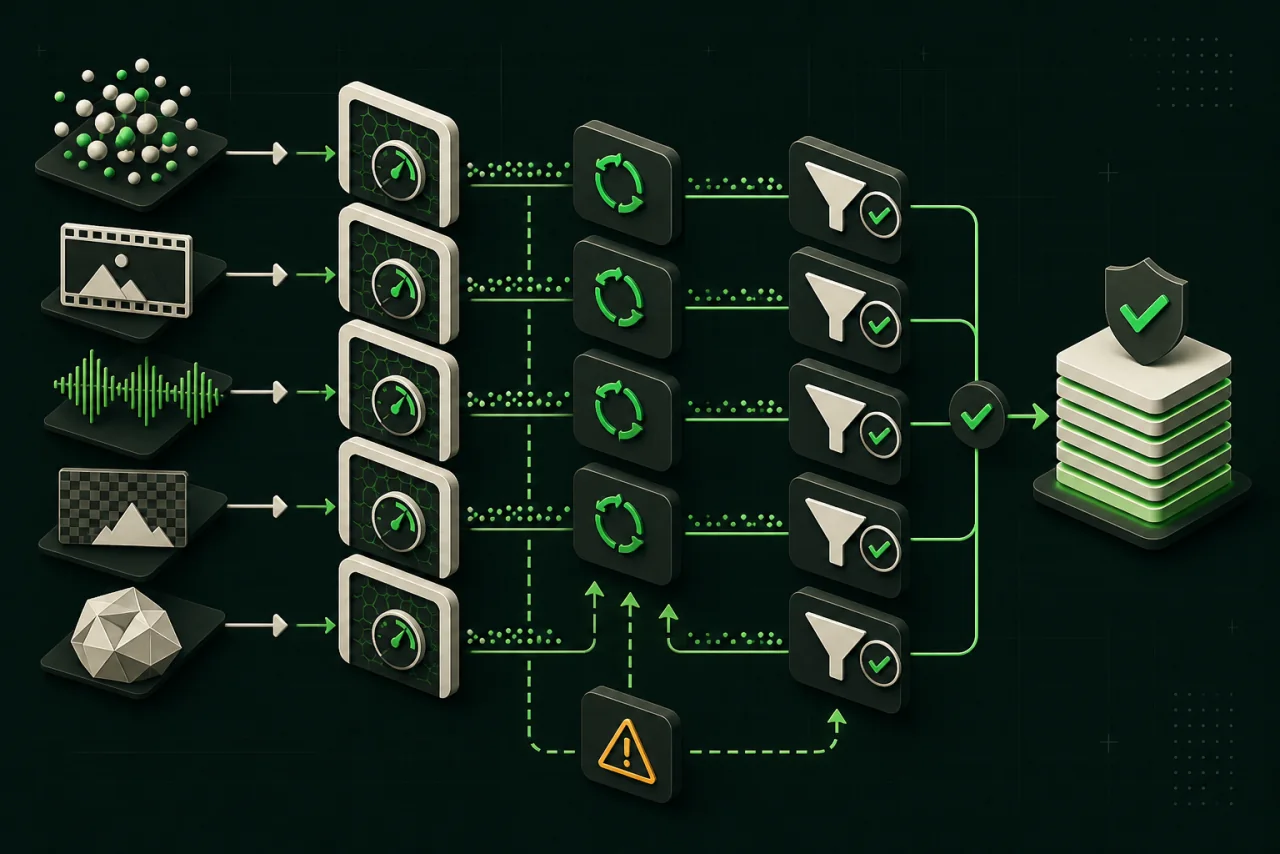
Transcription quotes are usually expressed per minute or per hour of submitted audio, while a product needs minutes it can actually use. The gap is retries: noisy recordings, overlapping speakers, unsupported languages, and failed requests all consume the same meter. This calculator divides accepted minutes by your own acceptance rate before applying the published rate, so the estimate reflects the audio you must buy rather than the audio you hope to keep.
Use a representative sample across short and long recordings, clean and noisy rooms, and every language in the product. Measure word error rate and, more importantly, whether the transcript passes the downstream task: search indexing, summarization, compliance review, or captions. A cheaper model that fails that task is not cheaper per accepted minute.
Published rates normalized to one minute
The table converts each first-party rate to USD per audio minute using arithmetic only. It does not assume the models are equally accurate, and it does not treat a promotional streaming rate as a permanent price.
These are the published rates on 2026-10-21. Providers change prices, model names, and promotional terms; recheck the linked source before committing volume.
| Provider and model | Published rate | Per audio minute | Notes |
|---|---|---|---|
| OpenAI gpt-4o-transcribe | $0.006 / minute | $0.006 | Listed transcription model |
| OpenAI Whisper | $0.006 / minute | $0.006 | Listed as Whisper |
| OpenAI gpt-4o-mini-transcribe | $0.003 / minute | $0.003 | Lower published rate |
| Deepgram Nova-3 pre-recorded, monolingual | $0.0043 / minute | $0.0043 | Pay-as-you-go; $200 free credit advertised |
| Deepgram Nova-3 pre-recorded, multilingual | $0.0052 / minute | $0.0052 | Pay-as-you-go |
| AssemblyAI Universal-3.5 Pro | $0.21 / hour | $0.0035 | Pre-recorded; $50 free credits advertised |
| AssemblyAI Universal-2 | $0.15 / hour | $0.0025 | Pre-recorded |
What the per-minute meter leaves out
A base transcription rate rarely includes every feature a workflow needs. Deepgram publishes separate per-minute add-on rates for redaction, keyterm prompting, entity detection, and streaming speaker diarization, while pre-recorded diarization is listed as included. AssemblyAI and OpenAI price additional products separately. Add those meters to the fixed-cost field or model them as a second calculation.
Streaming is a different service objective from pre-recorded transcription. Live audio is billed by connection time at rates that can exceed the pre-recorded rate, and the connection may stay open while nobody speaks. Do not use a streaming price to estimate a batch archive job, and do not use a pre-recorded rate to budget a live captions feature.
- Count submitted minutes, including failed and retried requests.
- Model add-on meters separately from the base transcription rate.
- Keep pre-recorded and streaming workloads in separate estimates.
- Recheck free-credit terms: they reduce the first invoice, not the unit rate.
- Verify language coverage and speaker diarization on your own recordings.
Common comparison mistakes
- Dividing an hourly rate by the wrong number or comparing it directly with a per-minute rate.
- Budgeting accepted minutes while the provider bills submitted minutes.
- Treating a promotional streaming rate as the permanent pre-recorded price.
- Ignoring diarization, redaction, keyterm, and entity add-ons.
- Assuming a free credit makes the ongoing unit cost lower.
Questions developers ask
Which speech-to-text API is cheapest?
On published base rates alone, AssemblyAI Universal-2 at $0.15 per hour is $0.0025 per minute, below Deepgram Nova-3 pre-recorded at $0.0043 and OpenAI at $0.003 to $0.006. The cheapest viable route is the one that passes your language, accuracy, and feature requirements at the lowest cost per accepted minute.
How do I convert an hourly transcription rate?
Divide the hourly rate by 60. For example, $0.21 per hour is $0.0035 per minute and $0.15 per hour is $0.0025 per minute. Enter the per-minute value in the calculator.
Should I use a free credit in the estimate?
Treat free credits as a first-invoice reduction, not a permanent discount. The calculator uses the ongoing published rate so the estimate remains valid after the credit is consumed.
Why does the calculator ask for an acceptance rate?
Providers bill submitted audio, but a product needs usable transcripts. The acceptance rate turns accepted minutes into the billable minutes you must purchase, including retries.